Showing posts with label vintage cookbooks. Show all posts

Uses for Lemons- 1902 Style


I love Annie Gregory's 1902 jewel of a book titled 'The Woman's Favorite Cook Book' where she states on the 1st page that she was assisted by 1000 housewives in compiling all of the recipes and tips in this very hefty book. (Wow) I especially love this little (and still useful) article called The Varied Uses of Lemon, It goes on to say:
" Every toilet table should be liberally supplied with lemons. The uses are so varied and so valuable that no one can overlook them. Among them is the fact that a teaspoon of lemon juice in a cupful of black coffee will drive away a headache. But if, on rising, the juice one half of a lemon be squeezed into a cupful of very hot water and drank with no sugar there will be no headache to drive away. A slice of lemon rubbed on the temples and back of the neck will also cure the headache. A solution of lemon juice should always be at hand. A little rubbed on the skin at night will whiten and soften it's texture. A fine manicure acid is made from a teaspoonful of lemon juice in a cupful of warm soft water. It will whiten discolored and stained fingernails. Lemon Juice in water will loosen the tartar that accumulates on the teeth. It makes the breath sweet. A slice of lemon rubbed over tan shoes which are then wped off with a soft cloth will remove black stains from their surface." Bessie Hill Porter

Antique Household and Reciept Books-A little info

I'd like to share some info about a type or category of cookbook that sometimes get overlooked but is an absolute favorite of mine. Sometimes refered to as books for the young housekeeper, cookery, or domestic receipt books, they are a true goldmine of information. They are for the most part classified as usually being published before 1901 (tail-end of the Victorian age) and almost always having 1 or more sections included other than recipes. The sections can include home remedies, housekeeping tips and schedules, home laundering instructions, marketing and menu planning, childbirth and nursing information, and the very common etiquette or social rules chapter. There's a reason I refer to these babies as the "one stop shops" or "all in one" antique cookbooks.


There's definitely cookbooks with subjects like these being published after 1901 and they are fabulous in their own right, there's also with later printings of the old hard to find originals that do have a place in a collectors world, but for now lets focus on the . Word of caution though, everybody has their own definition of the word "antique" and "vintage" and even though "generally" vintage is known for being 20 years or older. "Antique" is a little harder to nail down, being divided into 50% of collectors thinking 50 years or older and 50% thinking it's 100 years and older, but to the general public, the ones that have the bulk of the market, it seems to be anything older than yesterday. Please be forewarned that there are some (non-collector) sellers throwing the word "antique" on their 70's BH&G's and Taste of Home cookbooks, and really it IS inevitable that you will have to just hunker down and weed out all the Atkins and Jenny Craig's if your looking to purchase old cookbooks online to save money.

Speaking of weeding out, also be on guard for all the *expletive* Pdf files of download able cookbooks some nasty and unethical sellers are trying to get you to buy, trying to make it seem like your buying an actual printed book but after purchasing finding out it's only a cesspool of typos and bad grammar that would make Mrs. Beeton herself want to strangle someone. A general rule of mine though is "if it doesn't have a picture of the actual book itself, I'm not buying". That weeds out generally about 75% of them as the majority usually have (the same) stock cover photo attached to the listings along with INSANE prices leading you to think it's the real deal. This goes for current reprints as well, available at big box book stores.

So let's say you found one, YAY! and it's one that you've been looking for or maybe it just looks cool, the next step is to determine the condition, and yes it matters, as finding it is just half the battle. Condition is what really puts a value to the cookbook and tells you what you should spend. The rarer the cookbook, the more forgiveness is allotted to the condition. Same generally goes for age, the older it is, obviously the more wear it will have. BUT and this is a big but, and I understand it will be different for every collector but I will almost never buy a cookbook with loose pages or detached covers. Unless we're talking a 1700's Hannah Glasse or another one of a kind equivalent, where I shall not even think twice, generally these specific issues are too big to forgive. Remember these are investments! I recommend having an idea in your head and also price limits beforehand, as it's EXTREMELY easy to get excited and get caught up in that "omg, I have to buy it now before someone else does" feeling. Next thing you know you have it in your hands and are trying to hold back tears because it smells like mold, missing 12 pages and the cover came off while trying to open it. In my opinion, if I'm going to spend the kind of money that comes with some of these precious books, I'm going to get exactly what I want and then some, and if that means I might have to wait another 6 months until all the stars align and the right copy is available to me at the right time then so be it, it's what makes it exciting and I love that "treasure -hunting" feeling!

I'll be going into the 2nd half of this post and what's exactly found in these historic cookbooks, along with recipes, some household tips and remedies and more pics later tonight:)

1909 The Good Housekeeping Woman's Home Cookbook by Isabel Gordon Curtis

Isabel Gordon Curtis is one of my absolute favorite cookbook authors and this cookbook is an example of why. Her recipes are simple, classic and easy to follow. The history that sorrounds her makes her seem spunky yet classic, I love that. She came to America all the way from Scotland and in her lifetime she had quite a few very popular magazine editing jobs under her belt, Collier's Weekly, the Delineator and Success Magazine being just a few. While getting her start in the highly competitve magazine field she used to say that "No wider experience can be gained than in answering the questions that come from housekeepers to a home magazine. In learning how to solve problems for other people, you absorb a multiplicity of knowledge that cannot be achieved in one home." So combining a special lady like Curtis and a big name like Good Houskeeping, they made cookbook history.
This peticular cookbook was promoted as being the first to come out with the new slender size to help the housewife with it's space saving design, it also has blank sheets for notes on every other page. Good Housekeeping also prided itsef on it's recipes being tested by not only Curtis but company paid testers and it's magazine subscribers as well. It's a great example of one of Good Housekeeping's ideals as a company, to try and make housekeeping more efficient and buisness-like to take some of the stress out of running a house in the early 1900's. A true original and very special antique cookbook to collectors.

One from my Personal Collection

Wait for it....


Lol It starts off unassuming, almost dare I say ugly... then KABAM! Pages and pages of God knows how old, amazing, treasured, beautiful recipes. It's an accordian style folder-ledger and I just kept unfolding and unfolding...and then I realized that each page had it's own notepad! I have no idea how many actual recipes are in this gorgeous cookbook, but does it really matter...? It still makes me giddy looking at it!

New Vintage Recipes are Up

I just posted 2 recipes I found written in the back of a copy of The Rumford Cookbook in the "Just Recipes" page. One is for Wockey Cake with a recipe for the frosting, and one for Cranberry Pie just in time for the holidays! Let me know what you think!

Oh Mr Cleve Carney, how I love you...

I LOVE this cookbook! 1927 The Master cake Baker by Cleve Carney. I'll be listing it tomorrow but for now here's some sneak peek pics:)


Kitchen's of the 1920's

The 1920's kitchens were created with the thought that being modern, sanitary, and efficient were very important like women of the past decade had, the difference though was the loosening of the rules of any non essential decor being allowed, it was truly a period of sweet and in my opinion, really pretty kitchens.

Light and bright cheerful colors were used often and made the space seem bright and in many cases bigger than they were.


The invention of electricity made appliances absolutely mandatory and ad agencies made sure you (the consumer) knew that too.
Vacuum cleaners, washing machines, toasters, electric stoves, and fans were just a few of the fancy new tools designed to save time and add comfort to daily tasks.
Until the 1920s, appliances were popular, but during the 1920's, they became a MUST. Electric refrigerators replaced the ice box by the end of the decade, it was a huge shift that literally changed the way families ate.


The kitchens and recipes of the 1920's are one of my absolute favorites and I hope you can see why. In my opinion it's such a great balance of simplicity with warmth and comfort. To me they inspire me to combine sweet and homey with functionality and create a space that will make and my friends and family feel at home.

Kitchen's From the Late 1800's to the early 1900's


Here's some kitchens to make you think about how bad it really is the next time your dishwasher dies and you have to wash dishes by hand. Learning about these amazing ladies and how their

During the very early part of this time period, alot of kneeling was done in front of the hearth while you did your cooking and it took awhile for early stoves to progress to thier current height. The women that were lucky enough to own one I'm sure were happy nontheless. Here's a great and abolutely fascinating website if you love the look of antique stoves called StoveHospital. I stumbled upon it and am convinced we need one now:)

The last 2 pictures are from 1903 and are in the book "Homes And Their Decoration", by Lillie Hamilton French. You can read the full book by clicking the title of this post.

The most important issue in kitchen design of this time period was practicality and usefullness above all else. The authors of housekeeping and cookbooks, who were the rockstars of their time and were major movers and shakers of style and popular culture. These special ladies were trying to get others to leave the excessive and showiness of the victorian decorating style and thought that anything unnessesary or purely for decorative purposes was considered in bad taste. Some of the influence of this more minimalist syle came from all of the brand spankin new scientific data coming out about cleanliness and hygiene. Also the benefits of freash air in the home and the harmful effects of dust and ash and coal residue from fuels were big factors influencing how the typical housewife made her everyday choices.
It's funny though that looking at these kitchens today, with simplistic and minimalist in-style at the moment, I wonder what those authors and housewives from long ago would think of our kitchens:)

An appreciation for the past


This week I'm going to do a series showing examples of kitchens of the pasts. This idea came from encountering some people who *gasp* were wondering why some of us have such a love affair with vintage cookbooks. Yes they're out there!

For me one of the reasons is getting that knock down reality check that we all sometimes need when we think we have it hard. I think about the amount of love that the mothers and wives of the past would've had to have had to keep cooking day after day with none of the time saving equipment we take for granted today. It's one thing to say it must of been hard work but it's another to actually see what little they were working with and to imagine ourselves attempting to do it.

We see recipes today that have changed little over the years except in the way they are prepared and that is the part that we forget, the absolutely amazing unsaid preperations behind what are more than a just list of ingredients. To bake a cake in the 17th century meant to do it over an open flame and gauging temperaturing by sticking a piece of paper in and seeing how long it took to brown or sometimes even your hand went in, if you were a good cook. Can you imagine the watching and the waiting, even simple things like the adjusting of temperature took time and work, you didn't turn a knob like today, but had to add more wood or open your flue and you used ingredients that were precious and expensive and couldn't be purchased again if mistakes were made. Such pressure!

So when I come across an early cookbook and see notes about what worked and what didn't, I think that this recipe or this cookbook that I hold in my hands must be good if she went through all that she did and made it. Enjoy and let me know what you think:)

Back by popular demand!


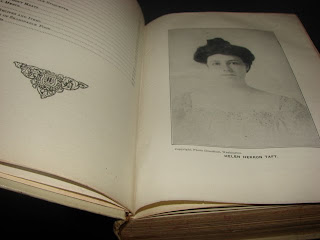
Here it is, one of the jewels! The White House Cook Book written by Hugo Ziemann who was once upon a time the steward of the White House, and Mrs. F.L. Gillette. It is a cookbook treasure that has a special place in cookbook collectors hearts. It's a hefty one with 609 pages and packed with cooking, toilet and household recipes, menus, dinner-giving tips, table etiqutte, care of the sick, health suggestions, facts worth knowing and etc. Also has pic of Helen Axson Wilson, this classic cokbook would put the current First Lady at the time of publishing on the title page. This copy also has pics of Helen Herron Taft and Frances Folsom Cleveland.

Crushed Banana Cake


This recipe is from one of the best cookbooks I have, it's from my personal collection and the lady that lovingly wrote down every single recipe is from my neck of the woods to make this cookbook extra special to me. I have no idea how old it is but from the pics it's resonable to say it's VERY OLD:)
Ps I wrote the recipe EXACTLY as written in the book

Crushed Banana Cake
Ingredients
1/2 C butter
1 C banana pulp (lol)
1 3/4 C sifted flour
1 tsp baking powder
1 1/2 cups sugar
4 Tbsp sour milk
1 tsp baking soda
1 cup chopped walnuts
1/2 tsp salt
2 eggs
Cream the butter, add sugar , then cream again, add the well beaten eggs and the cup of ripe banana pulp that had been ruffed through a sieve. Disslove the soda in the sour milk and beat into the mixture, and lastily add the flour sifted with the salt, add the baking powder. Beat well then add the chopped walnuts and bake in a pan in a moderate oven 15-20 min.

Bananas on FoodistaBananas
Vintage Cookbooks are for everyone who has ever wanted to bake something special and turned to a modern cookbook and realized they never seem to have all the ingredients at the same time, there're for history lovers that want to feel connected to the past in a way that's missing in history books, there're for the people that love that musty old book smell and laugh at kindle's, they're for people that feel like we as a society have gone a little too far, a tad off course with life and want to get back to the simple and the real, and they're for the people that want to pay homage to all the grandma's and great aunts that did it best!

CookbookAddict on Flickr - View my recent photos on Flickriver

My Store